On this page
- Some water near the filters and in the coarse strainer is normal; water after a finished cycle is not. 12
- Flash pair 1-5 (POTS/PANS once, NORMAL WASH five times) is the Drain Error. 12
- The Drain Error lists six checks, including the disposal plug, the hose high loop and the filters. 12
- Press and hold START for four seconds to reset the unit. 12
- No cycle should ever run with the filters left out. 12
Is water left in a Viking dishwasher after a cycle normal?#
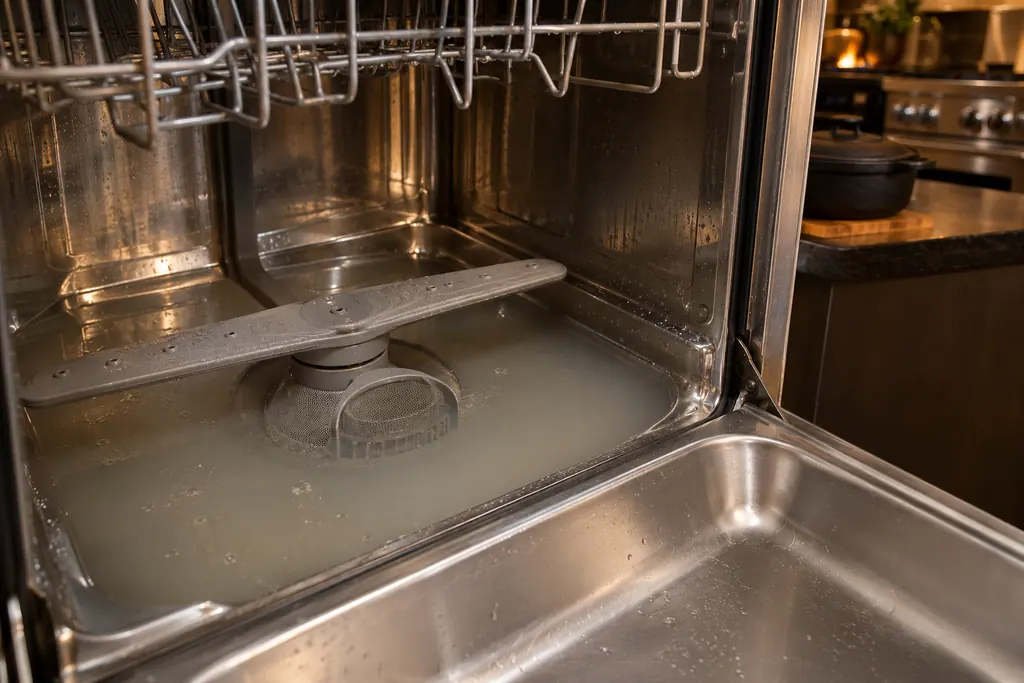
A small amount of water near the filters is normal, and so is water in the removable coarse strainer. Water that remains after the cycle has finished is not, and the Viking manuals treat it as a drain problem with a list of causes. 12
The troubleshooting tables for the 451 Series and the 324 Series have two separate rows. One says water left in the bottom near the filters: allow the cycle to complete, since some water is normal. The other says the dishwasher will not drain. 12 This guide is about the second row. Ours is a plain sequence, and each step is something the manuals print.
| What you see | Manual's explanation | Try first |
|---|---|---|
| A thin film near the filters, cycle finished | Some water is normal 12 | Nothing |
| Water in the removable coarse strainer | Normal 12 | Nothing |
| Water stands in the tub after the end | Drain hose clogged or kinked 12 | Look at the hose |
| Water gurgles up in the sink | Disposer and trap may be blocked 12 | Check the sink side |
| POTS/PANS 1, NORMAL WASH 5 | Drain Error 12 | Six checks, then reset |
What do the manuals list when the dishwasher will not drain?#
The row names a closed door, the controls being on, a water feed line that is not crimped and available water, then two hose causes: a drain hose that is clogged or blocked, and one that is kinked. Water backing up into the sink points at the disposer and trap. 12
Start with the easy ones. Make sure the door is firmly closed and the machine is switched on, because the row lists both. 12 Look at the hose where it connects: foreign particles can lodge at the entrance of the connection line, and the cone-shaped end must be cut to an inner diameter of at least 3/4 inch (1.9 cm). 12 Check for folds or sharp bends in the hose. The manual lists those as the kinked case. 12
How do I clear the strainer and the filters?#
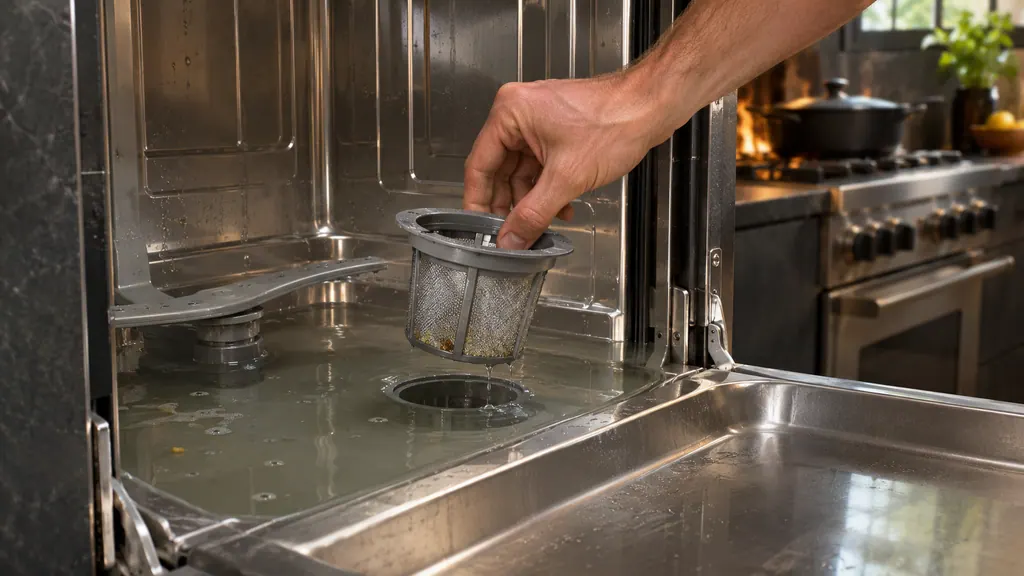
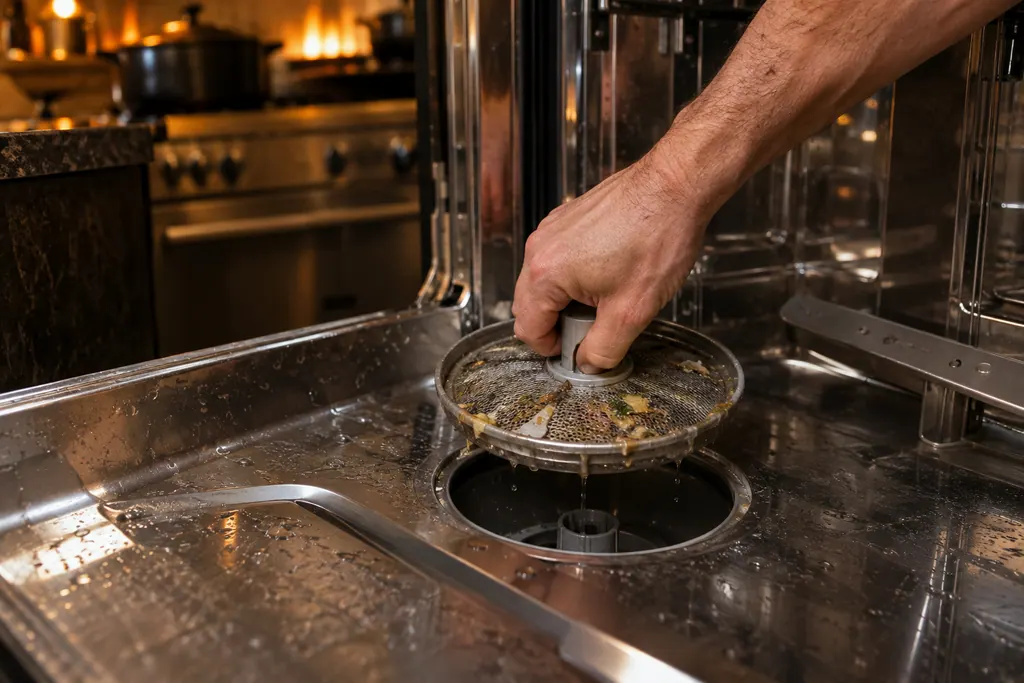
Take out the coarse strainer and empty it. If needed, rotate the fine filter free, clean every surface and refit both. Do not remove the primary filter. The manuals say to soak filters overnight in a half-and-half water and vinegar mix, or a citric cleaner and water. 12
Large food particles that cannot pass the drain pump collect in the coarse strainer, which makes it the first stop. 12 The manuals say that normally the filters clean themselves and need no upkeep, and that heavy soil, sediment or hard water may justify cleaning them after each use. Filters look bright when they are clean. 12 The warning is firm: never run the dishwasher without the filters in place. 12 Our filters entry describes the three parts.
- 1
- 2
- 3
- 4
- 5
What about the sink and the disposal?#
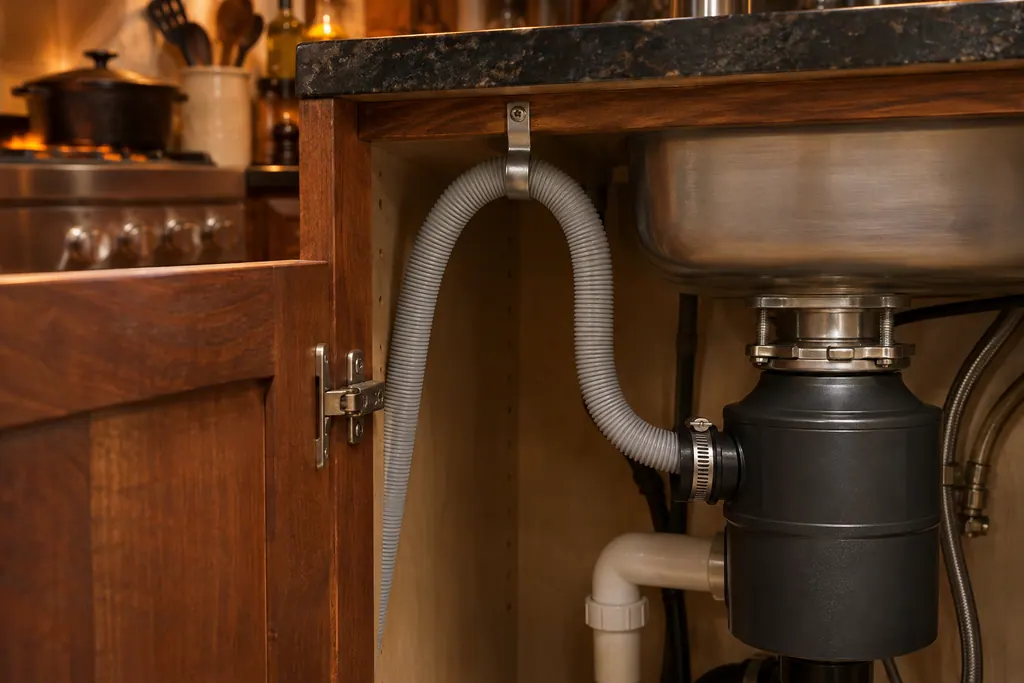
The tables tell you to check the food waste disposer and trap when water backs up in the sink while the dishwasher drains. The drain error list adds two more sink-side checks: run the garbage disposal with the tap on to prove the sink is not clogged, and remove the knockout plug if the hose goes into a disposal. 12
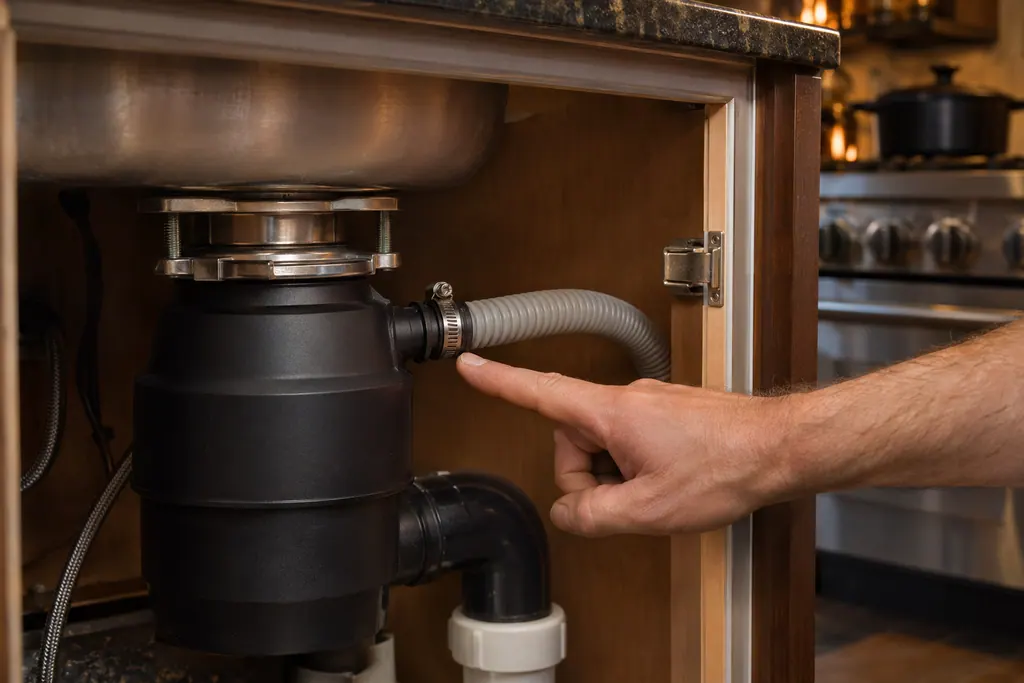
The charts list the plug as a check and give no reason. If a disposal was fitted or replaced lately, that plug is the first thing to confirm. The manuals I read do not mention an air gap, so nothing here depends on one.
What does the Drain Error flash pair mean?#
On both charts, the POTS/PANS light flashes once and the NORMAL WASH light flashes five times. The chart names it a Drain Error and lists six checks, ending with a reset and a note to contact service if the problem persists. 12
The six checks are: turn on the water at the sink and run the disposal; make sure the drain hose is not clogged or kinked; remove the disposal plug if draining into a disposal; confirm the drain hose has the high loop shown in the installation guide; confirm the dishwasher is level in both directions; and confirm the filters are not clogged. 12 Our 1-5 entry holds the same sequence.
The chart also prints 3-3 as a Drain Pump Error, with no checks apart from reset. 12 A 2-3 Low Level Sensor Error lists two checks that touch drainage: dishes that have turned over and are holding a lot of water, and the high loop. 12
Flash numbers are read as the count of flashes for each light. Note C gives the drain example itself. 12
How do I reset the machine?#
Press and hold the START button for four seconds. The unit resets, and you try the cycle again. If the same flash pair comes back, the charts send you to service, and for you that means booking with us. 12
Note A says the Pan Flood message flashes both lights continuously, so that message is a separate one from the drain pair. 12 Our dishwasher leaking page covers it. Note D explains that cycle and option buttons only light after they are selected, so a dark panel before you press START is expected. 12
Does the level of the dishwasher matter?#
Yes, the Drain Error list includes it. Check that the dishwasher is level in both directions. The same advice appears under the Fill Timeout and Fill Too Fast entries, so the machine's position affects more than the drain. 12
Leveling usually means adjusting the feet, which can need the machine pulled forward. If it cannot be leveled, or the hose needs rerouting inside the cabinet, that is service work, and a good reason to book rather than pull the unit out alone.
What helps a technician who comes for standing water?#
Say which series you have, whether water stands after a finished cycle, which flash pair showed, whether water backs up in the sink, whether a disposal is fitted, and what you cleaned. A photo of the hose run under the sink helps.
- Which lights flashed and how many times?
- Did the disposal and sink drain on their own?
- Was the filter set clean when you finished?
- Did a reset with START held for four seconds change anything?
Our dishwasher service page lists the series we repair. The drain hose entry explains the loop and the connection.
Sources#
- Viking Use & Care Manual / 451 Series Built-In DishwashersViking Range, LLC (official manual PDF) · form F20879C EN (022213) · PDF p.3 (safety), p.15 (filters and coarse strainer), p.16 (poor results table), p.18 (will not drain), p.19 (code chart and Notes B, C)
- Use & Care / 324 Series Built-In DishwashersViking Range, LLC (official manual PDF) · form F21216 EN (060113) · PDF p.14 (filters and coarse strainer), p.15 (poor results table), p.17 (will not drain), p.18 (code chart and Notes B, C)