Start from the symptom
Viking dishwasher not cleaning well.
A Viking dishwasher that leaves dishes dirty or cloudy is, per Viking's chart, mostly a loading, detergent or filter matter. Check the filters and strainer first, then the wash arms, rinse agent and detergent amount. Odor and slow drying have their own entries, covered below.
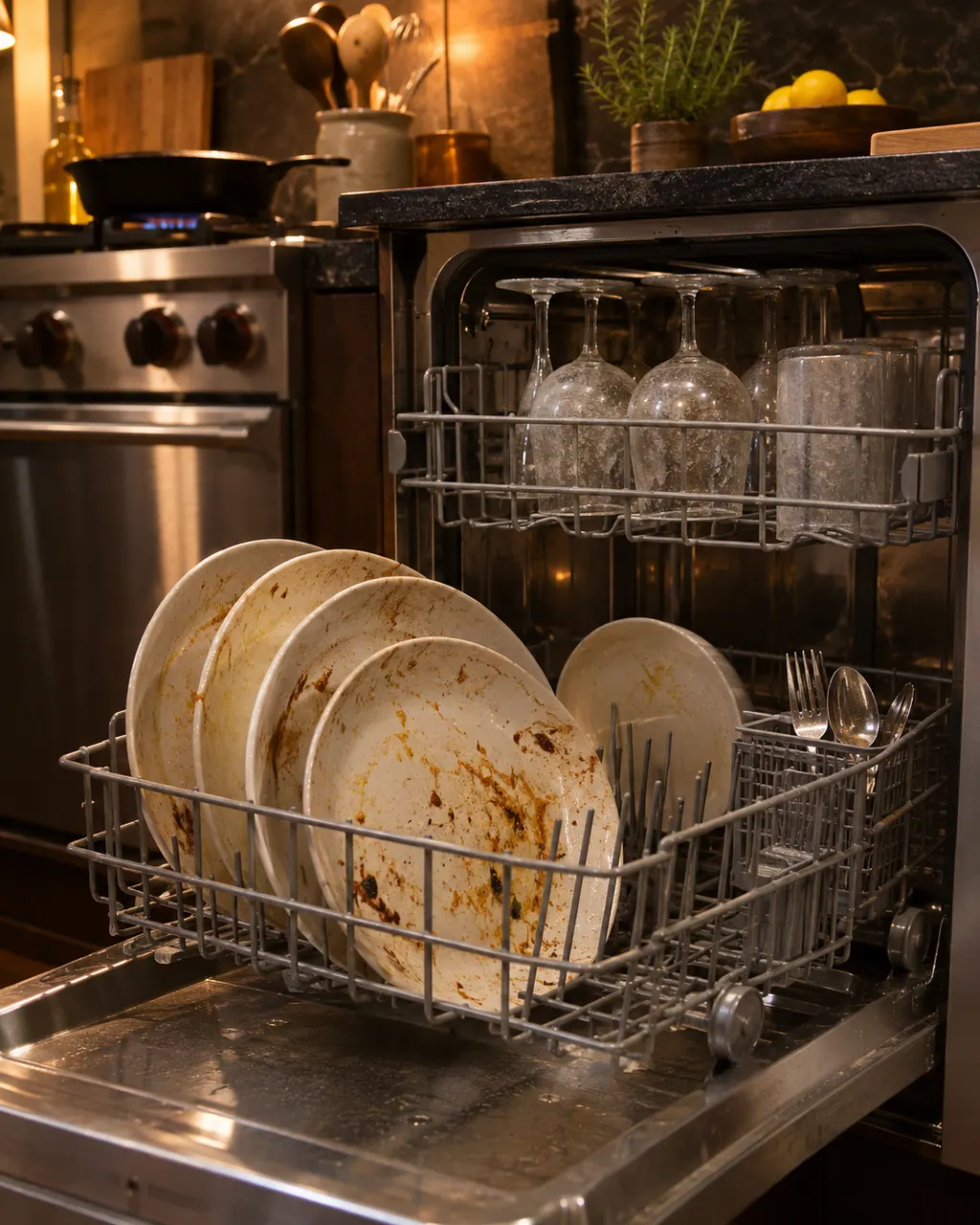
Start with safe observations.
Turn the appliance off and unplug it before any check you can make yourself. Beware of standing water and sharp edges. Never touch a wet plug or live wiring, take off service panels, or go beyond what your series' guide allows.
- 1
Filters and strainer
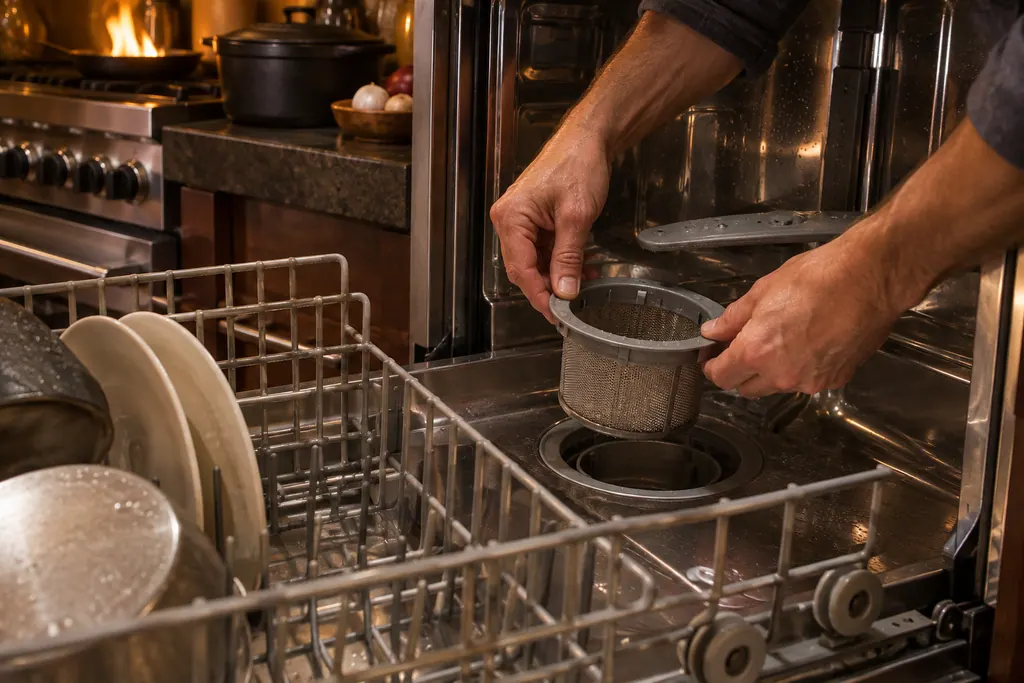
Make sure the filters are installed properly. Viking says a filter may clog from heavy sediment, food soil or hard water, and a blocked strainer should be checked and cleaned.
- 2
Wash arms
Both arms must rotate freely. Lift them, clear any grains of dirt, and check that no utensil or handle stops them turning.
- 3
Detergent and rinse agent
Use the amount that suits your water hardness and cycle. Fresh detergent only, stored dry and closed. For spotting, check the rinse agent dispenser.
- 4
Hard-water film
Wash and rinse as usual, remove metal items, add no detergent, and run a full program with 2 cups of vinegar in a bowl on the bottom rack. If that fails, repeat with 1/4 cup citric acid crystals. Etching from too much detergent is permanent.
- 5
Odors
Odors come from running every 2 to 3 days with soil left on dishes. Use the Rinse/Hold option between cycles, clear food chunks from the filter area, and use detergent with chlorine bleach plus an extra heat option. A plastic smell: 2 cups white vinegar in the lower rack, no detergent, longest cycle.
- 6
Drying
Allow more time with non-heat drying, fill the rinse agent dispenser, and expect some plastics to stay wet because they are hard to dry.
- 7
Loading
Do not overload. Load so water and detergent are not trapped between items, and keep spoons from nesting.
Systems a technician may investigate.
The parts below connect to this symptom. Seeing it does not establish that any one of them is the culprit.
Read the related care guide.
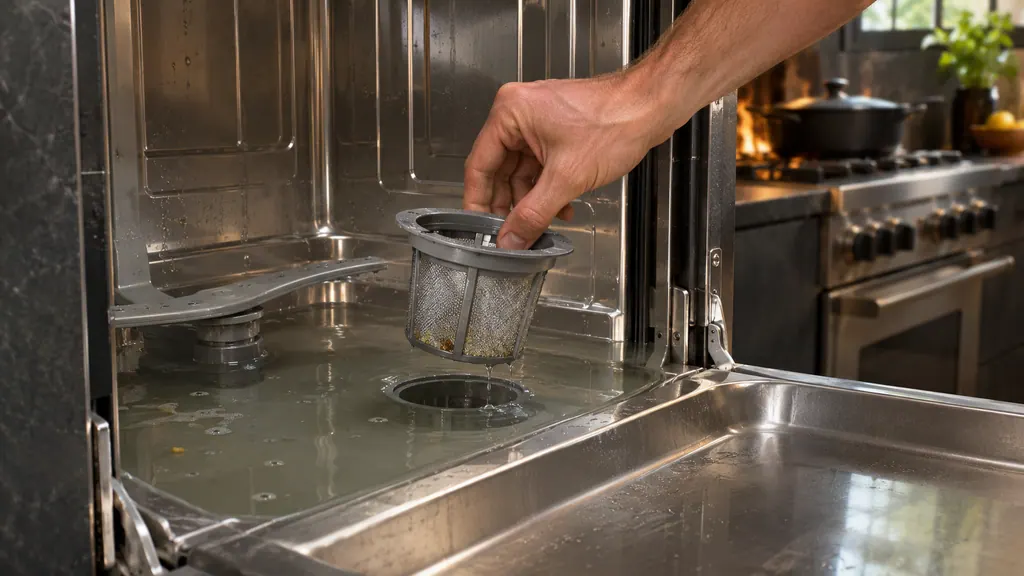
Water left in your Viking dishwasher? Check the strainer and hose.
On a Viking 451 or 324 Series dishwasher, standing water after a finished cycle is a drain problem, and the manuals list the checks in order: a closed door and power, a clean coarse strainer and filters, a drain hose that is not kinked or blocked, a disposal plug that has been removed, a high loop in the hose, and a level machine. Hold START for four seconds to reset. [1][2]

Pots/Pans or Normal Wash? Pick the right Viking cycle.
A Viking dishwasher picks the wash from five cycles on the 451 Series or four on the 324 Series: Pots/Pans for baked-on soil, Normal Wash for everyday loads, Light/China for delicate items, Fast Wash on the 451 only, and Rinse/Hold with no heat. Options such as Hi Temp Wash and Sanitized 155 F Rinse work only with Pots/Pans and Normal Wash. [1][2]
When observation becomes a service request.
Leave internal testing to a technician.
Filters, arms and loading are fine and results are still poor.
Cycle lights flash in a pattern; the code chart names the matching code.
Arrange a diagnosticSources and model boundaries.
The Viking dishwasher not cleaning well guidance rests on these references. Choose the manual that fits your own series.
- Viking Use & Care Manual / 451 Series Built-In Dishwashers
- Use & Care / 324 Series Built-In Dishwashers
Rely on the guide for your precise series, and read how we research these pages.
What does Viking check first when dishes come out dirty?
Poor results are not always the dishwasher. The chart points to the filters, a blocked strainer, wash arms that cannot spin, loading, rinse agent and the right amount of fresh detergent.
How do I treat hard-water spots in a Viking dishwasher?
Run a full program with 2 cups of vinegar in a bowl on the bottom rack and no detergent. If it fails, repeat with 1/4 cup citric acid crystals. Remove metal items first.
Why does my dishwasher smell?
Viking says running it only every 2 to 3 days lets bacteria grow in leftover soil. Use Rinse/Hold between cycles and clear food chunks from the filter area.
Do these steps apply to every Viking dishwasher?
They come from the 451 Series and 324 Series manuals. Another Viking series may print different steps, so check your model plate or book a visit.
Viking codes, symptoms, parts, visits
From the message to your next move.
1-5
1-5 means the POTS/PANS light flashes once and the NORMAL WASH light flashes five times. Viking's chart calls it Drain Error and lists six checks: sink, drain hose, disposal plug, high loop, level and filters.
Viking dishwasher not cleaning well
A Viking dishwasher that leaves dishes dirty or cloudy is, per Viking's chart, mostly a loading, detergent or filter matter. Check the filters and strainer first, then the wash arms, rinse agent and detergent amount. Odor and slow drying have their own entries, covered below.
Filters and the coarse strainer
A Viking 451 or 324 Series dishwasher keeps a coarse strainer, a fine filter and a primary filter in its base, under the lower rack. Viking says never to run the machine without the filters in place. You lift out and empty the strainer, can twist out the fine filter, and should leave the primary filter alone.
Dishwasher repair
Book a diagnostic for your series at the appliance itself.
Find your metro
Office particulars and the entry details to give us.