On this page
- Pots/Pans uses a long heated prewash and the highest wash temperatures; Normal Wash is the cycle behind the energy label. 12
- Fast Wash and Top Wash exist on the 451 Series only. 12
- Hi Temp Wash and Sanitized 155 F Rinse are limited to Pots/Pans and Normal Wash on both series. 12
- Delay Start reaches 10 hours on the 451 Series and 4 hours on the 324 Series, and is not offered with Rinse/Hold. 12
- After you press START, close the door within 4 seconds or three short beeps sound. 12
Which cycles does a Viking dishwasher have?#
The 451 Series has five wash cycles: Pots/Pans, Normal Wash, Light/China, Fast Wash and Rinse/Hold. The 324 Series has four, because Fast Wash is not listed. Each model prints its own list, so read the one for your series first. 12
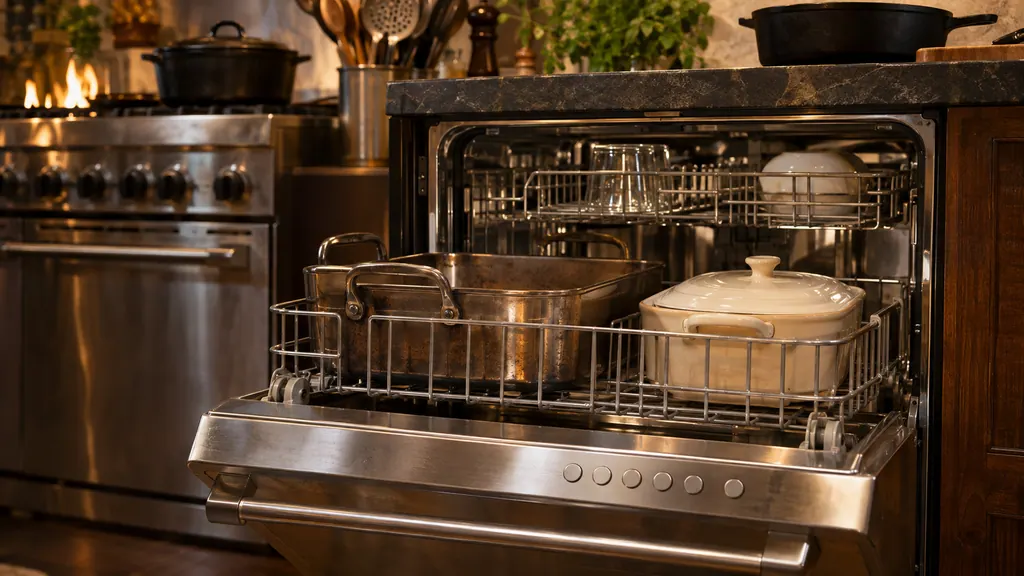
A Viking dishwasher is built for the kind of load a serious home cook produces: sheet pans, stockpots, casserole dishes and the crystal that came out for the same dinner. The cycle names say what each one is for, and the cycle table in each manual puts numbers behind the names. This guide reads those tables side by side and explains how the option buttons fit around them. The audible signals have their own guide, dishwasher beeps and how to silence them.
| Cycle | Purpose in the manual's words | 451 Series | 324 Series |
|---|---|---|---|
| Pots/Pans | Heavily soiled pots, pans and casserole dishes; long heated prewash, high temperature main wash and final rinse | Yes | Yes |
| Normal Wash | Normally soiled dishes; the energy-usage label is based on this cycle | Yes | Yes |
| Light/China | Lightly soiled items, china and crystal; lower temperatures | Yes, lower pressure too | Yes |
| Fast Wash | Light films and residue on dishes and glassware; short wash times | Yes | Not listed |
| Rinse/Hold | All dishware; short rinse with no heat | Yes | Yes |
What do the cycle numbers tell you?#
The cycle data tables give approximate water use and time for each cycle. Pots/Pans uses the most water and time, Rinse/Hold the least, and Normal Wash sits near the middle. The manuals call every figure approximate and dependent on installation and conditions. 12
Here are the printed figures for each series. Temperatures are the main wash and the last rinse.
| Cycle | 451 Series temperatures | 451 water and time | 324 Series temperatures | 324 water and time |
|---|---|---|---|---|
| Pots/Pans | 145 F main, 150 F rinse | 8.4 gal, 138 min | 130 F prewash and rinse, 145 F main, 150 F last rinse | 8.3 gal, 131 min |
| Normal Wash | 120 F main, 140 F rinse | 4.25 gal, 110 min | 120 F main, 140 F last rinse | 4.25 gal, 117 min |
| Light/China | 125 F main, 130 F rinse | 5.4 gal, 112 min | 120 F main, 135 F rinse | 5.6 gal, 101 min |
| Fast Wash | 130 F main, 135 F rinse | 5.8 gal, 60 min | Not listed | Not listed |
| Rinse/Hold | Rinse | 1.4 gal, 10 min | Rinse | 1.4 gal, 8.5 min |
Three notes sit under the tables. The 451 Series manual says heating delays to reach the set temperatures may extend cycle times, and that AirFlo Gentle Drying adds roughly one hour to the total. The 324 Series manual says the wash time does not include the 30 minute condensate dry time. The 451 Series manual also says the dishwasher will perform properly on cold 50 F water, with longer cycle times. 12
If a cycle seems to run long, the tables are the first place to look. A Pots/Pans load on the 451 Series is meant to take over two hours, and a Normal Wash close to two. Neither is a sign of a problem by itself.
When should I use Pots/Pans and when Normal Wash?#
Use Pots/Pans for heavily soiled cookware and casserole dishes, and Normal Wash for ordinary dinner dishes. Pots/Pans begins with a long heated prewash that loosens encrusted food, then runs a high temperature main wash and final rinse. 12
Normal Wash is the everyday cycle, and it is the one behind the printed energy-usage label. It is also the cycle that accepts the most options. Both manuals add that you do not need to rinse normal food soil off the dishes first, although larger pieces such as bones, seeds, skins, pits and toothpicks should come off. 12
One caution applies to flatware. If the load will wait before it runs, the manuals say to rinse salty and highly acidic foods off stainless steel, silver and silverplate, because long contact with lemon juice, salt, vinegar, mustard, mayonnaise and salad dressings can cause pitting. 12
What do the option buttons add?#
Options modify a cycle you have already chosen. Hi Temp Wash adds heat, time and water. Sanitized 155 F Rinse raises the final rinse to 155 F. Top Wash washes the top rack only on a 451. Delay Start holds the cycle for up to 10 hours on a 451 or 4 hours on a 324. 12
- Top Wash (451 Series only): washes dishes on the top rack only, and is available only with Normal Wash. 1
- Hi Temp Wash: increases the temperature, adding heat, time and water for improved cleaning. It is available only with Pots/Pans and Normal Wash, and periods of soaking occur to help remove baked-on soil. 12
- Sanitized 155 F Rinse: raises the water temperature to 155 F in the final rinse and adds heat and time. Per the manuals, it sanitizes to NSF/ANSI Standard 184 for residential dishwashers; it is certified for homes, not for commercial kitchens. 12
- Delay Start: press the button once and the number 2 lights for a two hour delay; keep pressing to step toward the maximum, then press START and shut the door. It is not available with Rinse/Hold. 12
The restrictions are worth memorizing, because a button that seems dead is usually one the chosen cycle does not accept. Hi Temp Wash and Sanitized 155 F Rinse are not offered with Light/China (and, on the 451, not with Fast Wash). Rinse/Hold takes no options. 12
Why will the option I want not light?#
Because the cycle you chose does not allow it. The option restriction list in both manuals is the full answer: Hi Temp Wash and Sanitized 155 F Rinse need Pots/Pans or Normal Wash, Top Wash needs Normal Wash, and Rinse/Hold accepts none. 12
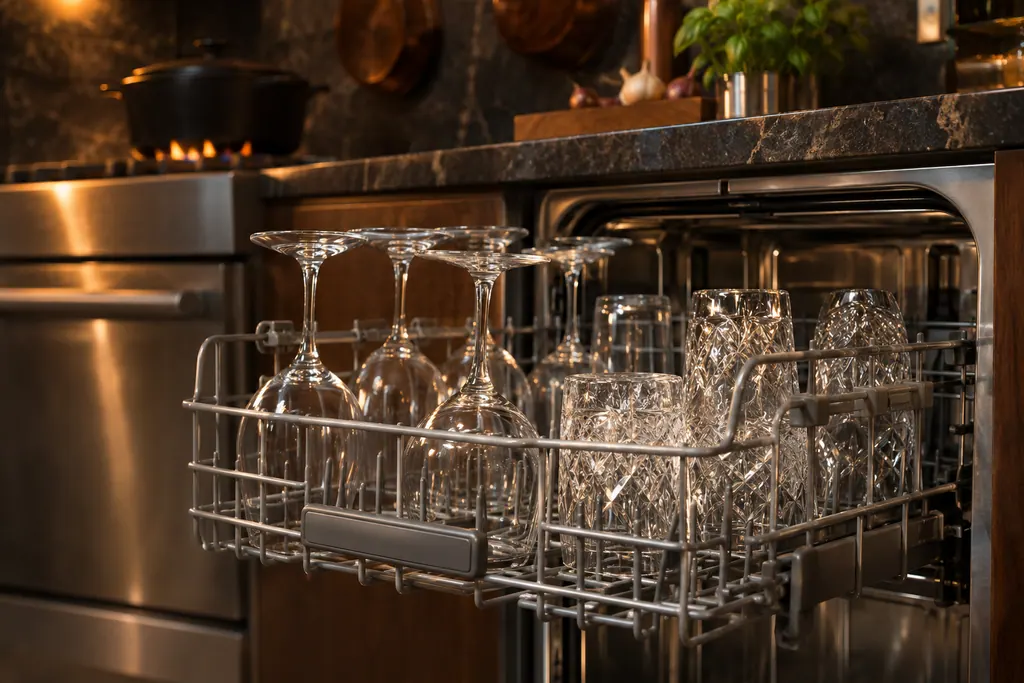
Change the cycle first, then choose the option. If you want a delicate wash with extra heat, the manuals do not offer it; pick Normal Wash and load the crystal in the top rack, or run Light/China without options.
How do I start a cycle so that it actually runs?#
Load the racks, check rinse agent and detergent, push both racks in, choose a cycle and options, press START and then pull the door shut until it clicks. The manuals add that an unclosed door means the cycle never begins. 12
- 1
- 2
- 3
- 4
- 5
A dark control panel before you press anything is not an error. The manuals state that Option, Cycle and Start buttons illuminate only after they are selected, and that you press START to activate the dishwasher. 12 Our dishwasher that will not start page lists what else stops a start: an open door, a Delay Start left on, a closed water supply, an unplugged cord or a blown fuse. 1
What do the lights show during and after a cycle?#
The lit buttons show the choices you made. A blue Power On light under the kickplate shows a running 451 cycle, and Start/Resume blinks when a cycle is interrupted. The Sanitized indicator lights when a sanitizing cycle finishes. 12
The Sanitized indicator is the one owners ask about most. It lights at the end of a completed cycle with the sanitizing rinse. If it stays dark, the manuals give two reasons: the cycle was interrupted, or the water could not be heated to the required temperature. The light goes out after you open and close the door, or when you press and hold START/RESUME. 12
The 451 Series adds a blue Power On light that shines from the bottom middle of the kickplate while a cycle runs, and it blinks when a cycle is interrupted. 1
What if the cycle buttons flash instead of staying lit?#
Flashing cycle buttons are a code, not a cycle. Both manuals point you to the flash code chart, which counts the flashes of the Pots/Pans and Normal Wash lights. For example, one flash then five flashes is the drain error, and a reset is a 4 second hold of START. 12
That chart lives on our dishwasher error code library, not here, because the numbers differ between the 451 and 324 Series. Fill Too Fast, for example, is 4-2 on one chart and 4-5 on the other.
Which cycle fixes common wash problems?#
Match the symptom to the manual's own remedies. For dishes that are not clean, check that both wash arms spin freely and that the strainer is clear. Spotting and filming point to hard water, rinse agent and detergent amounts. Cloudy glass is permanent etching from too much detergent. 1
The troubleshooting charts in the 451 Series manual give a few cycle-related answers worth knowing. A yellow or brown film can be treated with citric acid crystals in place of the prewash detergent, followed by a full detergent wash on the Pots/Pans or Normal Wash cycle. A plastic smell can be cleared with two cups of white vinegar in a dishwasher-safe cup on the lower rack, no detergent, on the longest cycle with an extra heat option. An odor from running every two or three days can be eased with the Rinse/Hold option between cycles and a detergent with chlorine bleach plus an extra heat option. 1
For a deeper look at the cases where cycle choice is not the issue, see the Viking dishwasher not cleaning page, the filters entry and the dishwasher service page.
What do I record about the load?#
Write down your series (451 or 324, printed on the manual cover), the cycle and options you chose, what the lights did, and whether Sanitized lit. That tells a technician whether you are seeing normal behavior or a real problem.
- Which cycle and which options did you select?
- Did the Start/Resume or Power On light blink during the cycle?
- Did the Sanitized light come on at the end?
- Did any cycle button flash, and how many times?
- What does the identification label give as the model number?
Sources#
- Use & Care Manual, 451 Series Built-In DishwashersViking Range Corporation (official manual PDF) · form F20879C EN (022213) · PDF p.6-7 (Features: Cycles, Cycle Data, Option Restrictions)
- 324 Series Built-In Dishwashers Use & CareViking Range, LLC (official manual PDF) · form F21216 EN (060113) · PDF p.6-7 (Features: Cycles, Cycle Data, Option Restrictions)